Zextons E-Commerce Platform
Full-stack e-commerce platform serving 1,000+ products, with SSR-powered SEO, a shopping cart and wishlist, dual payment gateways (Stripe and PayPal), and a comprehensive admin dashboard.
- Next.js
- TypeScript
- React
- Redux Toolkit
- Node.js
- Express.js
- MongoDB
- Tailwind CSS
- ShadcnUI
- Stripe
- PayPal
Private project, demo on request
This is client or employer work, so the source code is confidential and the live app sits behind a login. I can't share screenshots or credentials publicly, but I'm happy to walk you through it on a call: a live demo, the architecture and selected code.
Architecture
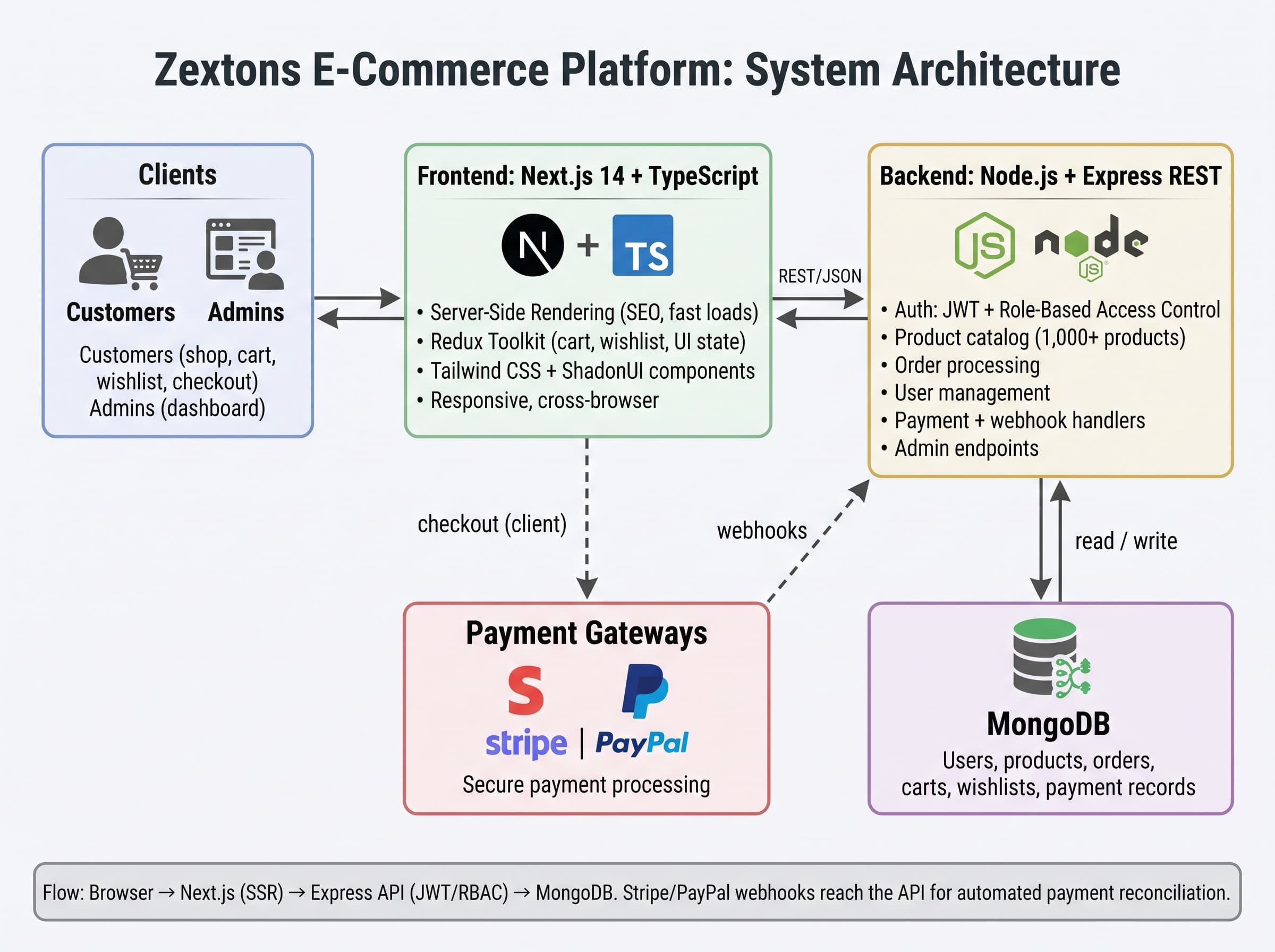
Overview
Zextons is a full-stack e-commerce platform built with Next.js 14, TypeScript, Node.js, Express.js, and MongoDB. It separates the server-rendered frontend from a REST API backend, providing SEO-friendly product discovery, secure authentication, reliable order processing, and integrated payment gateways.
The frontend handles product browsing, cart management, and the checkout experience, while the backend manages business logic, access control, orders, and payment reconciliation.
System
Next.js 14 + TypeScript
  │  SSR · Tailwind CSS · ShadcnUI
  │  Redux Toolkit (cart, wishlist, UI state)
  ▼
Node.js + Express.js REST API
  │  JWT authentication · Role-based access control
  ├──► MongoDB (users, products, orders, payments)
  ├──► Stripe (payment processing + webhooks)
└──► PayPal (payment processing + webhooks)Key design decisions
Server-side rendering for SEO and performance. Product and category pages use SSR to improve search engine discoverability and reduce page load times by 40% across a catalog of 1,000+ products.
Centralized client-side state management. Redux Toolkit manages the cart, wishlist, and UI state, reducing prop-drilling and keeping shared state consistent across components.
Secure authentication and authorization. JWT authentication secures API access, while role-based access control (RBAC) enforces customer and admin permissions at the backend, preventing unauthorized access to administrative operations.
Webhook-based payment reconciliation. Stripe and PayPal webhooks notify the backend of payment events. The API reconciles transactions against their corresponding orders, reducing reliance on browser-side checkout state and supporting reliable payment processing.
Responsive and reusable UI. Tailwind CSS and ShadcnUI provide a consistent, responsive interface with cross-browser compatibility across devices.
Quality and performance
- 40% reduction in page load times through server-side rendering across 1,000+ products.
- 99.9% transaction uptime reported for the payment workflow.
- Secure API endpoints with JWT authentication and server-side role enforcement.
- Automated payment updates through Stripe and PayPal webhooks.
- Centralized state management for cart, wishlist, and interface interactions.
Key Implementation Highlights
Server-Side Rendering with Next.js 14 improved SEO and reduced page load time by 40% across 1,000+ products
FrontendRedux Toolkit state management cut prop-drilling by 40% and improved rendering performance by 30%
FrontendTailwind CSS and ShadcnUI components with 100% mobile responsiveness and cross-browser compatibility
FrontendRESTful APIs in Node.js, Express.js and MongoDB for authentication, catalog, orders and user management
BackendJWT-based authentication with role-based access control (RBAC)
SecurityStripe and PayPal integration with automated webhook reconciliation, 99.9% transaction uptime
PaymentsComprehensive admin dashboard for managing products, orders and users
AdminShopping cart and wishlist
Feature
Interested in the technical details?
Let's Talk